How to Get TRON Energy: Staking vs Renting
Published: · 5 min read
Short answer
There are three ways to get TRON energy: stake (freeze) TRX — about 9.6 energy per staked TRX per day, so ~6,700 TRX covers one USDT transfer a day; rent energy — 65,000 energy for 3 TRX, delivered in seconds; or do nothing and let the network burn TRX (~6.43 TRX per transfer). Renting is cheapest unless you already hold thousands of TRX.
If you searched “tron how to get energy”, you probably just saw a USDT transfer burn 6 or 13 TRX and want to stop that. There are only three sources of energy on TRON — staking, renting and burning — and the right choice depends on one thing: how much TRX you already hold. Below is how each works, step by step, with numbers read from the network on October 8, 2026.
What is TRON energy
What is TRON energy? It is the resource that pays for running smart contracts. Every USDT transfer is a smart-contract call, so it needs energy: about 64,285 units if the recipient already holds USDT and 130,285 if they don’t.
What is TRON energy and bandwidth, together? Bandwidth is the second resource: it pays for the size of any transaction. Every activated address receives 600 free bandwidth per day, enough for about one USDT transfer; energy, on the other hand, is never free — you either have it or the network burns TRX for it at 0.0001 TRX per unit. That is why energy is 95% of the usdt trc20 fee.
Energy cannot be bought on the market like a token. You get it in one of three ways:
| Way | What you do | Cost per USDT transfer |
|---|---|---|
| Burn | nothing — the network takes TRX automatically | ~6.43 TRX (≈ $2.14) or ~13.03 TRX |
| Stake | lock your own TRX for energy | 0 TRX, but thousands of TRX locked |
| Rent | someone delegates energy to you | 3 TRX or 6 TRX |
Way 1: stake (freeze) TRX
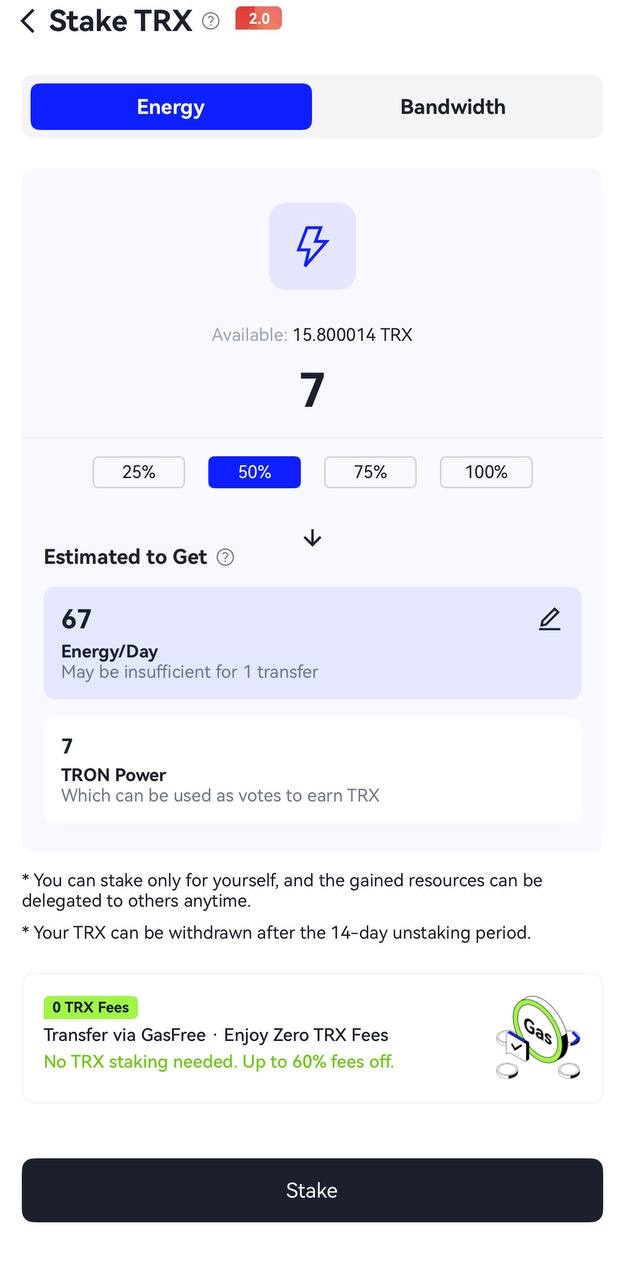
Under Stake 2.0 (TRON’s current staking system) you lock TRX and choose which resource it produces: energy or bandwidth. Your address then receives a share of the network’s daily energy pool proportional to your stake. Today 1 staked TRX gives about 9.6 energy per day.
This is how to get energy in your Tron Link wallet (TronLink):
- Open TronLink and tap your TRX balance or the Resources section, then Stake (Stake 2.0).
- Choose Energy as the resource.
- Enter the amount of TRX to stake. The app shows how much energy you will get.
- Confirm and sign. Energy appears on your address within a block or two.
- (Optional) Use the Tron Power you received to vote for a Super Representative and earn voting rewards.
Other wallets work similarly. This is also how to get energy in tron wallet apps such as Trust Wallet (TRX → Stake) and MetaMask mobile, which added TRON staking in 2026; the menus differ, but you always choose “Energy” as the resource.
Two things people miss:
- Energy regenerates over 24 hours, it is not a daily lump sum. If you spend it all at once, it refills gradually.
- Unstaking takes 14 days. After you unstake, the TRX stays locked for 14 days before you can withdraw it. Plan for that.
Use the calculator to see how much you would need to stake for your volume. It reads the live staking ratio from the network:
Stake 2.0 energy calculator
- Energy per day
- —
- USDT transfers per day
- —
- TRX to stake
- —
- Renting the same for 30 days costs
- —
Way 2: rent energy
Renting means someone who already staked TRX delegates part of their energy to your address for a short time using Stake 2.0’s built-in delegation. Ownership of the TRX never moves; only the right to use the energy does. You pay a small fixed price, make your transfer, and the delegation ends.
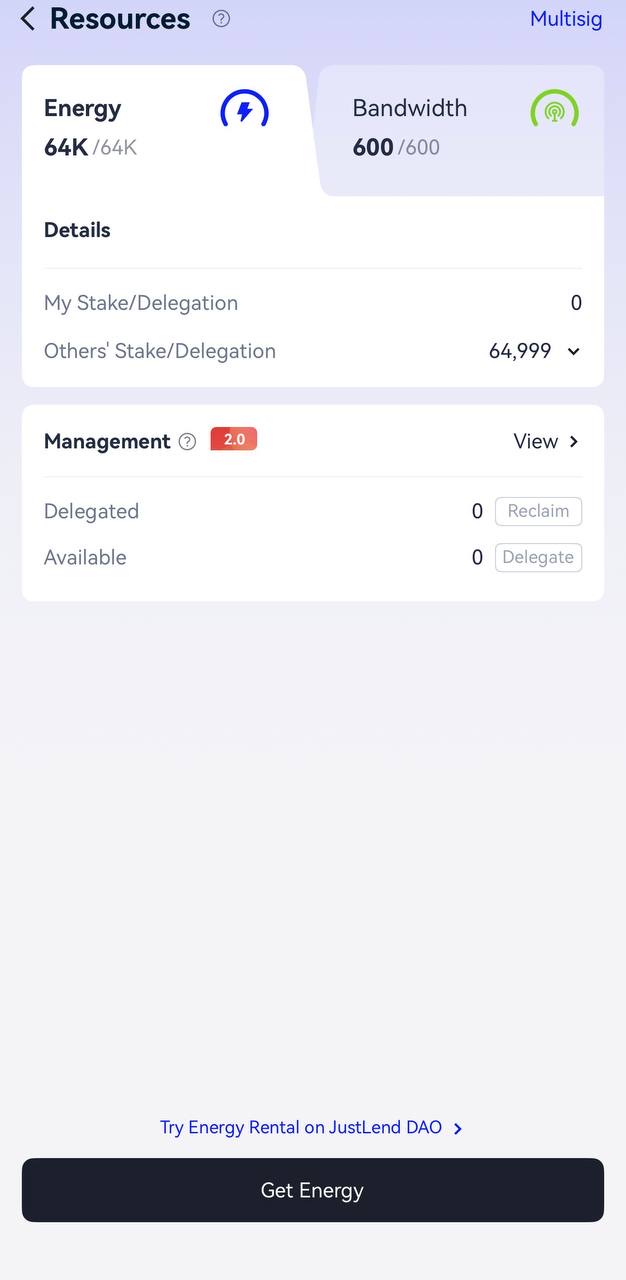
This is how to get energy without tron staking of your own — and, in practice, how to get enough energy for tron trx transfers when you hold little or no TRX. Rental options fall into three groups:
| Type | How you pay | Typical use |
|---|---|---|
| Telegram bots and direct-payment services (like ours) | send TRX to an address or pay from a bot balance | one transfer at a time, delivered in seconds |
| Marketplaces / order books | place an order for an amount and duration | larger volumes, longer periods |
| On-chain rental via DeFi platforms (e.g. JustLend DAO) | deposit TRX as rent through a smart contract | users comfortable with DeFi interfaces |
With us, renting takes one step: send 3 TRX (65,000 energy) or 6 TRX (131,000 energy) to our address from the wallet that will send USDT, or buy in the Telegram bot. Energy arrives in seconds and stays for 1 hour.
Staking vs renting: cost comparison
Staking looks free, but it is not: you lock capital that could do something else, and you carry TRX price risk for at least 14 days. Here is the honest comparison for one USDT transfer per day to an address that holds USDT:
| Stake | Rent | Burn | |
|---|---|---|---|
| TRX needed upfront | ~6,700 TRX locked (≈ $2231.10) | 3 TRX per transfer | 6.43 TRX per transfer |
| Cost over 30 days | 0 TRX burned | 90 TRX (≈ $29.97) | 192.9 TRX (≈ $64.24) |
| Flexibility | low — 14-day unstaking | high | high |
| Price risk | on ~6,700 TRX | none | none |
| Extra | voting rewards on staked TRX | — | — |
The break-even question is simple: is 90 TRX a month (the rental cost) more or less than what your 6,700 TRX would earn or protect elsewhere? For most people who send USDT but do not want to hold thousands of TRX, renting wins. For large holders who already keep TRX long-term and send many transfers every day, staking wins.
Which option is right for you
- You send USDT a few times a month and hold little TRX → rent energy before each transfer. Cheapest and simplest.
- You send daily and already hold 10,000+ TRX long-term → stake for energy and rent only on busy days.
- You send once a year → burning TRX is fine; it is a few dollars.
- You have USDT but zero TRX → rent energy paid from a bot balance, or see the other options in our guide to sending USDT without TRX.
Whatever you choose, the goal is the same: get tron energy onto your address before you press Send. Ready to stop burning TRX? Buy tron energy in seconds.
FAQ
How much TRX do I need to stake for one transfer?
With today’s network numbers (1 staked TRX ≈ 9.6 energy per day), about 6,700 TRX covers one USDT transfer per day to an address that holds USDT, and about 13,500 TRX covers one transfer to a new address. The ratio changes as more TRX is staked network-wide, so check the live staking calculator before you lock funds.
Does energy regenerate?
Energy from your own stake does. It recovers gradually over 24 hours: if you use all of it at 10:00, it is fully back by 10:00 the next day. Rented energy does not regenerate for you — it is delegated for a fixed period and then returns to the owner.
How long does rented energy last?
It depends on the provider. Ours stays on your address for 1 hour, which is plenty for one transfer; buy it right before you send. Some marketplaces rent for days or weeks, which only makes sense if you send many transfers in that period.