USDT TRC20 Fee in 2026: How Much It Costs and Why You Pay in TRX
Published: · 6 min read
Short answer
On October 8, 2026 a USDT TRC20 transfer from your own wallet costs ~6.43 TRX if the recipient already holds USDT and ~13.03 TRX if they don’t — paid by burning TRX because the transfer needs energy. With rented energy the same transfers cost 3 TRX and 6 TRX. Exchanges charge their own flat withdrawal fee instead, typically 0.5–2 USDT.
Most articles about the USDT TRC20 fee still quote 2024 numbers — “about 1 USD”, “15 TRX”, “345 bandwidth and that’s it”. TRON has cut its energy price since then, and the TRX price moved too. Below are the numbers checked on the network on October 8, 2026, with dollar values that update live while you read.
Short version of the trc20 fees picture:
| Sending USDT TRC20… | Cost today | In USD (live) |
|---|---|---|
| From your wallet, recipient holds USDT, no energy | ~6.43 TRX | ≈ $2.14 |
| From your wallet, recipient has no USDT, no energy | ~13.03 TRX | ≈ $4.34 |
| From your wallet with rented energy | 3 TRX / 6 TRX | ≈ $1.00 / ≈ $2.00 |
| Withdrawal from an exchange | 0.5–2 USDT flat | see the table below |
What determines the USDT TRC20 fee (energy and bandwidth)
On TRON you never pay “gas” in the Ethereum sense. Every transaction consumes two resources:
- Bandwidth pays for the size of the transaction in bytes. A USDT transfer is about 345 bytes. Every activated address gets 600 free bandwidth points per day, so the first transfer of the day usually costs nothing for bandwidth; after that, the network burns 0.001 TRX per byte — about 0.35 TRX.
- Energy pays for running smart-contract code. USDT is a smart contract, so every transfer needs energy: 64,285 units if the recipient already holds USDT, 130,285 if they don’t (measured on mainnet on October 8, 2026).
If your address has energy — staked or rented — the transfer uses it and burns nothing. If it has none, TRON converts the missing energy into TRX at the current network price, 100 sun per unit (0.0001 TRX), and burns that TRX from your balance. That is the whole trc20 transaction fee formula:
fee in TRX = energy used × 0.0001 + bandwidth (0 or ~0.35)
The energy price is a network parameter voted on by TRON’s Super Representatives. It stood at 420 sun for a long time, was cut to 210 sun and later to today’s 100 sun. Every time it changes, every article with hard-coded numbers goes stale — that is why the live fee table further down reads the current value.
Why the fee doubles when the recipient has no USDT
The USDT contract stores one number per holder: their balance. When you send USDT to an address that already has a balance, the contract updates two existing numbers. When the recipient has never held USDT (or their balance is exactly zero), the contract must create a brand-new storage entry — and writing new storage is the most expensive operation in the TRON virtual machine.
Result: the same 10-USDT trc20 transfer fee jumps from ~6.43 TRX to ~13.03 TRX, just because of who receives it. Typical cases:
- Cheap case (~64k energy): exchange deposit addresses, merchants, friends who already use USDT.
- Expensive case (~130k energy): a wallet someone just created, a new deposit address, or an address that emptied its USDT balance.
You can check any address before sending — paste it into the checker below or the tron energy calculator.
Fee on exchanges vs from your own wallet
When you withdraw USDT from an exchange, you do not pay TRON’s network fee directly. The exchange sends the transaction from its own hot wallet (which has plenty of staked energy) and charges you a flat withdrawal fee instead. That fee is set by the exchange, not the network, and it varies a lot:
| Exchange | TRC20 | ERC20 | BEP20 | Note |
|---|---|---|---|---|
| HTX | 0.5 USDT | 0.3 USDT | 0.01 USDT | |
| Bitget | 1.5 USDT | 2 USDT | 0.01 USDT | |
| OKX | 1.5 USDT | 0.71 USDT | in app | min. withdrawal 10 USDT |
| KuCoin | 1.99 USDT | 5.5 USDT | 1 USDT | |
| Binance | 1.5 USDT | in app | in app | |
| Bybit | 1.5 USDT | in app | in app |
Exchanges change withdrawal fees without notice. The amount on the withdrawal screen is the one you pay.
A few things stand out:
- The binance trc20 withdrawal fee is 1.5 USDT (October 2026) — the same as Bybit and OKX (OKX also has a 10 USDT minimum). Binance does not publish it on a public page; you see it on the withdrawal screen.
- trc20 vs erc20 fees on exchanges: at most exchanges the TRC20 withdrawal is cheaper than ERC20 (KuCoin: 1.99 vs 5.5 USDT), but not everywhere — in October 2026 OKX and HTX charged less for ERC20 than for TRC20, because Ethereum gas was unusually low.
- trc20 vs bep20 fees: BEP20 (BNB Smart Chain) withdrawals are often the cheapest of all, from 0.01 USDT. The catch: the receiving side must accept BEP20, and many P2P traders, merchants and payment services only take TRC20.
Withdrawing from an exchange makes sense when you send to one recipient anyway. If you pay many people from your own wallet, the network fee matters more — and that is the part you can cut.
3 ways to pay less: stake, rent, keep TRX
- Stake TRX for energy (Stake 2.0). Locking TRX gives your address energy that regenerates every 24 hours. Today 1 staked TRX produces about 9.6 energy per day, so covering one transfer per day to a USDT holder takes roughly 6,700 TRX locked, with a 14-day unstaking period. Great if you already hold that much TRX; useless if you don’t. Full walkthrough: how to get tron energy.
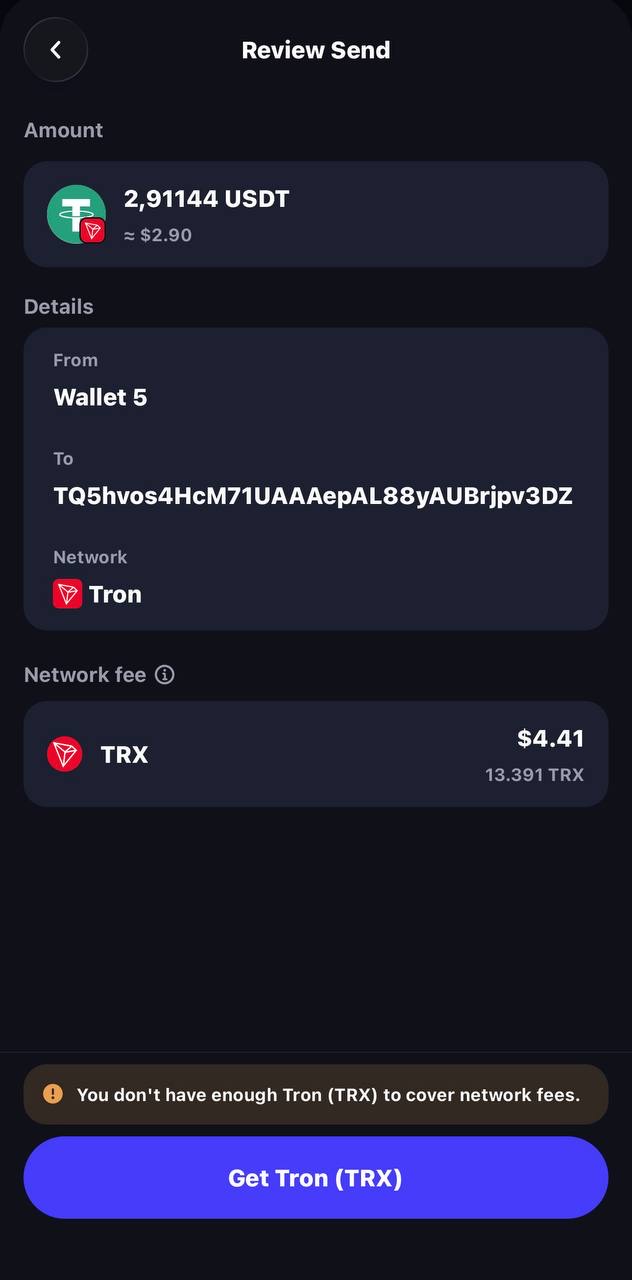
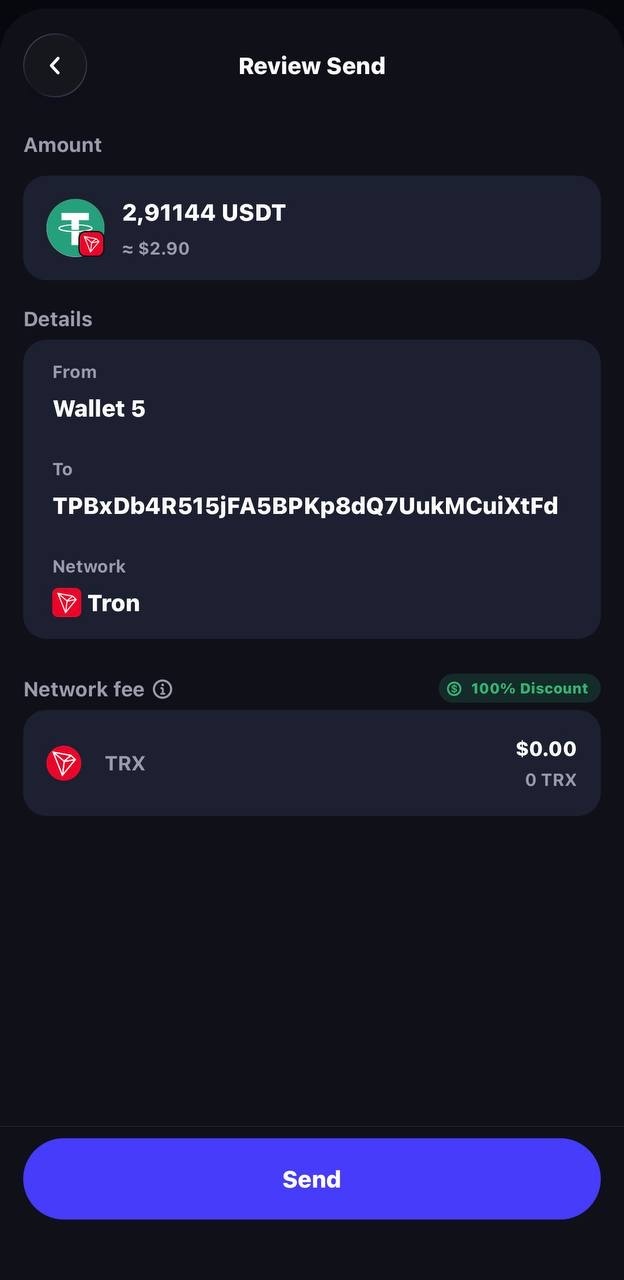
- Rent energy for each transfer. Pay a small fixed price and receive energy for a short time. With us: 65,000 energy for 3 TRX or 131,000 energy for 6 TRX — about 53% less than burning. No capital locked, nothing to manage. You can buy tron energy in the Telegram bot or by sending TRX from your wallet.
- Keep TRX and burn it. The default. Fine for one transfer a month; expensive for anything regular.
There are a few more tricks — batching, choosing recipients that already hold USDT, gas-free wallets. We compared all six in how to reduce trx fee. And if your problem is the opposite — you have USDT but zero TRX — read how to send usdt without trx.
Example: fee with and without rented energy
Say you pay 20 suppliers a month. Twelve of them already hold USDT, eight receive it for the first time.
| Without energy | With rented energy | |
|---|---|---|
| 12 transfers to holders | 12 × 6.43 = 77.2 TRX | 12 × 3 = 36 TRX |
| 8 transfers to new addresses | 8 × 13.03 = 104.2 TRX | 8 × 6 = 48 TRX |
| Total per month | 181.4 TRX (≈ $60.41) | 84 TRX (≈ $27.97) |
| Per year | 2,177 TRX | 1,008 TRX |
Saving: about 97 TRX a month, roughly 1,170 TRX a year — for doing nothing more than renting energy before each payment.
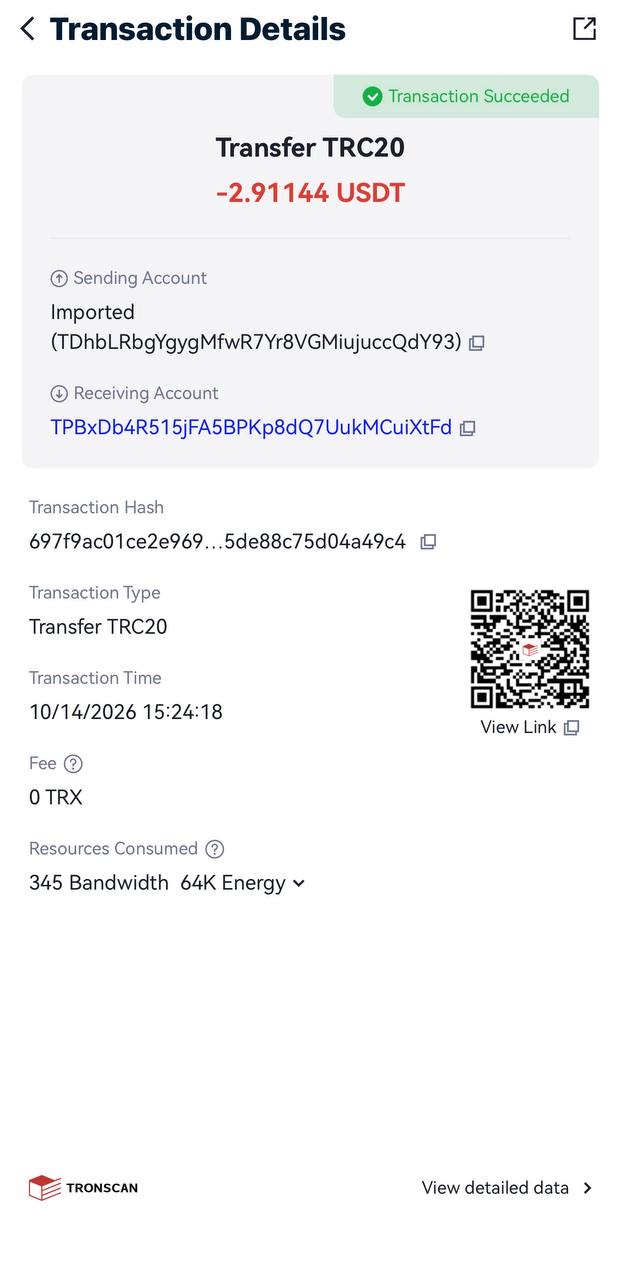
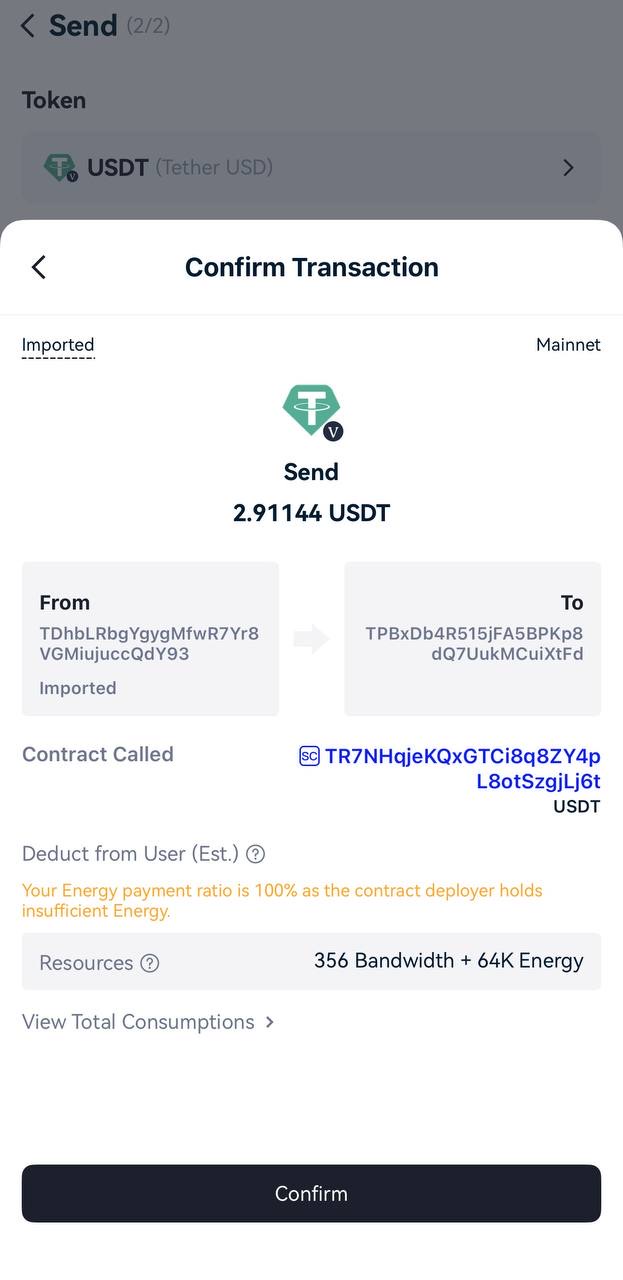
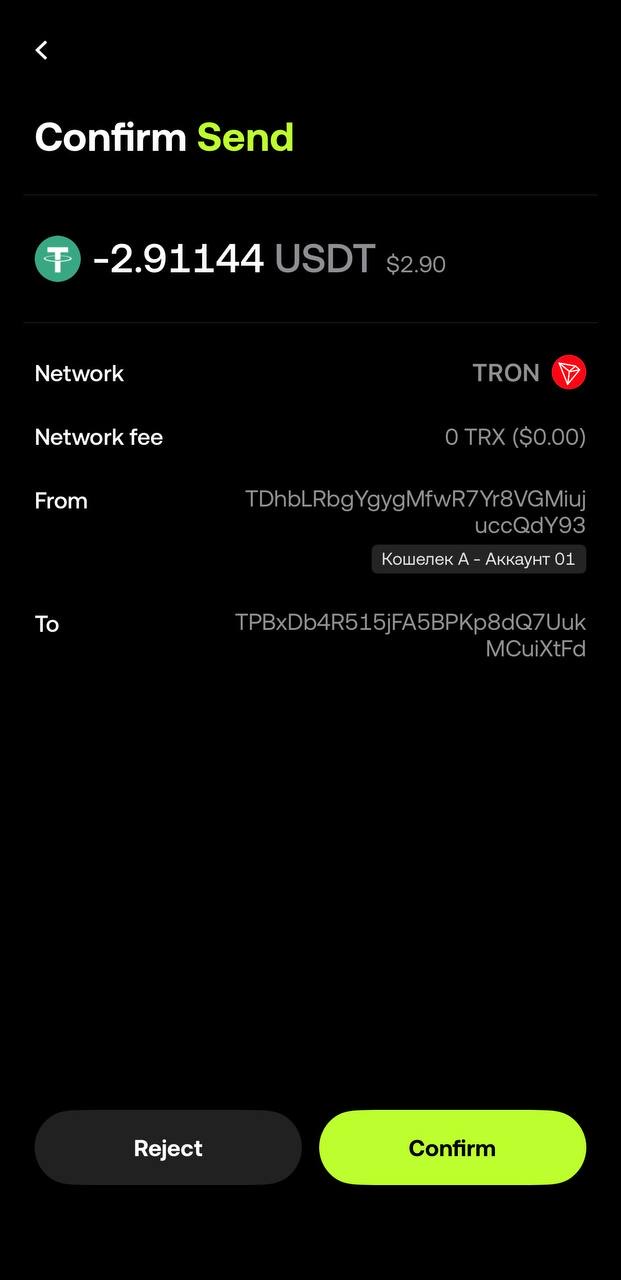
This is what it looks like in practice — the same USDT transfer sent with rented energy:
How does that compare with other networks? The live table below shows what one USDT transfer costs on each network right now, using public RPC data:
| Network | To a USDT holder | To a new address |
|---|---|---|
| TRC20 (TRON), TRX burned | loading… | loading… |
| TRC20 (TRON), rented energy | loading… | loading… |
| TRC20 via GasFree | loading… | loading… |
| ERC20 (Ethereum) | loading… | loading… |
| BEP20 (BNB Smart Chain) | loading… | loading… |
| Arbitrum One | loading… | loading… |
| Solana (SPL) | loading… | loading… |
TRC20 rows exclude bandwidth (~0.35 TRX, free for the first transfer of the day). GasFree: Fixed fee in USDT, no TRX needed (official GasFree service; wallets may differ). Solana: Base fee is tiny; +0.002 SOL account rent if the recipient never held USDT. Gas and prices are loaded live from public RPC nodes and OKX when you open the page. Wallets may add their own margin. Static figures checked October 8, 2026.
So when people compare erc20 vs trc20 fees, the honest answer in late 2026 is: on-chain, Ethereum is often cheaper on quiet days, BEP20 and L2s are cheaper still, and TRON is the most predictable and most widely accepted. If the recipient accepts several networks, pick the cheapest one in the table above; for a full comparison of networks and exchanges, see the cheapest way to send usdt. And if you stay on TRON — which is where most USDT lives — the trc20 network fees are the part you can halve with energy.
FAQ
Why did I pay so much TRX for one transfer?
Most likely the recipient had no USDT balance. Creating a new balance record in the USDT contract costs about 130,285 energy instead of 64,285, so a wallet without energy burned around 13 TRX instead of 6.4 TRX. If you also sent several transfers that day, you may have paid ~0.35 TRX of bandwidth on top.
Is TRC20 cheaper than ERC20?
Not always any more. In October 2026 Ethereum gas is low, and an on-chain ERC20 USDT transfer costs roughly $0.30–0.50, while a TRC20 transfer burns about $2–4 of TRX without energy and about $1–2 with rented energy. TRC20 remains the most widely accepted network for USDT, and on exchanges TRC20 withdrawals are often cheaper than ERC20 ones. Compare live numbers in our cheapest-way guide.
Can I send USDT with zero fee?
Only if somebody else pays. Your own staked energy makes transfers free at the moment of sending (but locks thousands of TRX), some wallets run temporary zero-gas promotions, and internal transfers between users of the same exchange are usually free because nothing happens on the blockchain. A regular on-chain TRC20 transfer always consumes energy, which someone has to provide.