TRON Bandwidth vs Energy: What’s the Difference?
By TRX Economy team · Published: · 4 min read
Short answer
Bandwidth pays for the size of a transaction (bytes); every address gets 600 free per day. Energy pays for running smart contracts and is never free. A TRX transfer uses only bandwidth (~268). A USDT transfer uses both: ~345 bandwidth + ~64,285 energy (or ~130,285 to a new address). Energy is the expensive part — over 90% of the USDT fee.
Most explanations of TRON bandwidth and energy were written in 2018–2019, before Stake 2.0 and before USDT made TRON the busiest stablecoin network. This guide uses today’s numbers and a real USDT transfer to show what each resource does and what it costs you. The short version of tron energy vs bandwidth: bandwidth is cheap and partly free, energy is where your TRX goes.
What is bandwidth
Bandwidth pays for the size of a transaction in bytes. Every transaction — a TRX transfer, a USDT transfer, a vote — has a size, and that size consumes bandwidth.
- Every activated address gets 600 free bandwidth per day, restored gradually.
- If you need more, you can stake TRX for bandwidth (today ~1.6 bandwidth per staked TRX per day).
- If you have none left, the network burns TRX instead: 0.001 TRX per byte (1,000 sun).
A plain TRX transfer is about 268 bytes, so the free allowance covers about two of them a day.
What is energy
Energy pays for computation — running smart-contract code. Only transactions that call a smart contract need it: USDT and every other TRC20 token, DEX swaps, DeFi.
- There is no free energy. You get it by staking TRX, by having it delegated (rented) to you, or the network burns TRX for it.
- The burn price is 0.0001 TRX per unit (100 sun) as of October 2026.
- A USDT transfer needs about 64,285 energy to an address that holds USDT and about 130,285 to one that doesn’t.
That makes energy the expensive part: ~6.43 TRX (≈ $2.14) of a USDT transfer versus ~0.35 TRX for bandwidth at most.
Which transactions use which resource
| Transaction | Bandwidth | Energy | Cost if burned |
|---|---|---|---|
| Send TRX | ~268 | 0 | 0 (free allowance) or ~0.27 TRX |
| Send a TRC10 token | ~280 | 0 | 0 or ~0.28 TRX |
| Send USDT to a holder | ~345 | ~64,285 | ~6.43 TRX + 0–0.35 TRX |
| Send USDT to a new address | ~345 | ~130,285 | ~13.03 TRX + 0–0.35 TRX |
| Send TRX to a brand-new address | ~268 | 0 | +1.1 TRX account activation |
| Swap on a DEX | a few hundred | varies by contract | depends on the contract |
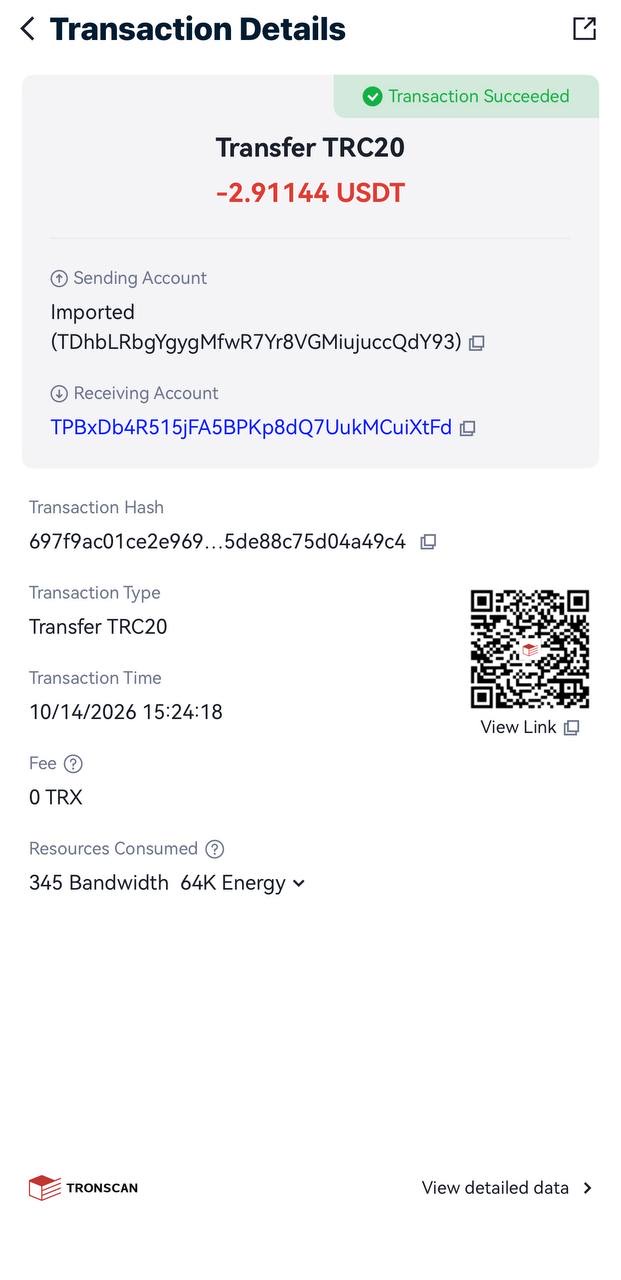
Here is a real USDT transfer on Tronscan — 345 Bandwidth + 64K Energy, fee 0 TRX because both were covered:
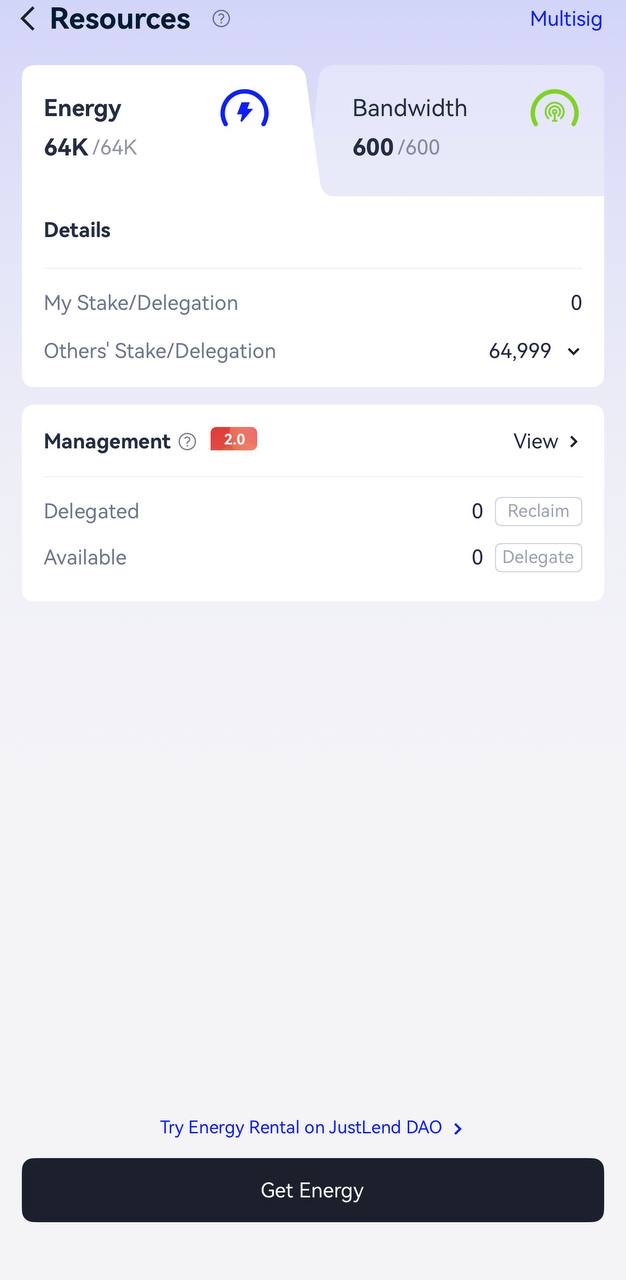
So when people ask what is tron energy and bandwidth, the practical answer is: bandwidth for the envelope, energy for the work inside it.
Free daily bandwidth
The 600 free bandwidth points are the only free resource on TRON:
- They apply per activated address and refill continuously over 24 hours.
- They cover the bandwidth of one USDT transfer or about two TRX transfers per day.
- A brand-new address that has never received TRX is not activated yet and has no free bandwidth — and cannot send anything until someone sends it TRX.
If you send USDT several times a day, the second and later transfers each burn ~0.35 TRX for bandwidth on top of the energy — still small compared with energy.
How to get more of each
More bandwidth:
- Wait — the free 600 refill within 24 hours.
- Stake TRX for bandwidth: about 1.6 bandwidth per TRX per day, so ~215 TRX covers one extra USDT transfer’s bandwidth daily.
- Let the network burn ~0.35 TRX per transfer — often the simplest.
More energy:
- Stake TRX for energy: about 9.7 energy per TRX per day, so ~6,600 TRX per daily USDT transfer. This is the tron staking bandwidth or energy choice — one stake, one resource; when in doubt about tron bandwidth or energy, stake for energy if you send tokens.
- Rent energy: 65,000 energy for 3 TRX, delivered to your address in seconds.
- Let the network burn ~6.43–13.03 TRX per transfer.
Many people search how to buy energy and bandwidth for tron address in one go. In practice you only need to buy energy: bandwidth is covered by the free allowance for most users, and energy is more than 90% of the fee. You can buy tron energy for a single transfer — no staking, no seed phrase.
The full fee breakdown, including exchange withdrawals, is in usdt trc20 fee. For staking and renting step by step, see how to get tron energy.
FAQ
Do I need bandwidth to send USDT?
Yes, about 345 bandwidth per USDT transfer — but your 600 free daily bandwidth usually covers it. If you have already used the free allowance today, the network burns about 0.35 TRX for it. The big cost of a USDT transfer is energy (~64,285 units), not bandwidth.
How much free bandwidth do I get per day?
600 bandwidth points per activated address per day, restored gradually over 24 hours. That covers about two TRX transfers or one USDT transfer’s bandwidth. Beyond that, the network burns 0.001 TRX per byte, or you can stake TRX for more bandwidth.