TRON Staking for Energy (Stake 2.0): How Much TRX You Need per Transfer
By TRX Economy team · Updated: · 4 min read
Short answer
Under Stake 2.0 you lock TRX and choose Energy or Bandwidth. Your address then gets a daily share of the network’s resources — today about 9.7 energy per staked TRX. One USDT transfer a day to a holder needs about 6,600 TRX staked. Unstaking takes 14 days. Staking pays off for large holders; for most users renting energy is cheaper.
Most guides to tron staking energy are written either for developers (API calls, no numbers) or by a service that only wants to sell its own staking. This one is for people who send USDT and want to know one thing: is it worth locking TRX to get free energy? The numbers below are read from the TRON network — the calculator updates them live.
How Stake 2.0 works
Stake 2.0 is TRON’s current staking system (it replaced the older “freeze” mechanism in 2023, which is why many people still say “freeze TRX”). It works like this:
- You stake TRX and choose a resource — energy or bandwidth. This is the classic tron staking bandwidth or energy decision: one stake produces one resource.
- The network gives you a share of its daily pool. TRON produces a fixed amount of energy per day (180 billion units) and bandwidth (43.2 billion). Your share is proportional to your stake compared with everyone else’s.
- Resources regenerate continuously. Energy you use comes back gradually over 24 hours.
- You also get TRON Power — one vote per staked TRX. Voting for a Super Representative earns voting rewards in TRX.
- You can delegate your energy or bandwidth to another address without giving away the TRX. This is exactly how energy rental services work: they delegate energy from their stake to your address for a while.
How to freeze tron for energy, step by step (TronLink):
- Open TronLink → tap your TRX → Stake (marked 2.0).
- Choose Energy.
- Enter the amount. TronLink shows the estimated energy per day.
- Confirm and sign. Energy appears on your address in a few seconds.
- Optional: vote with your TRON Power to earn rewards.
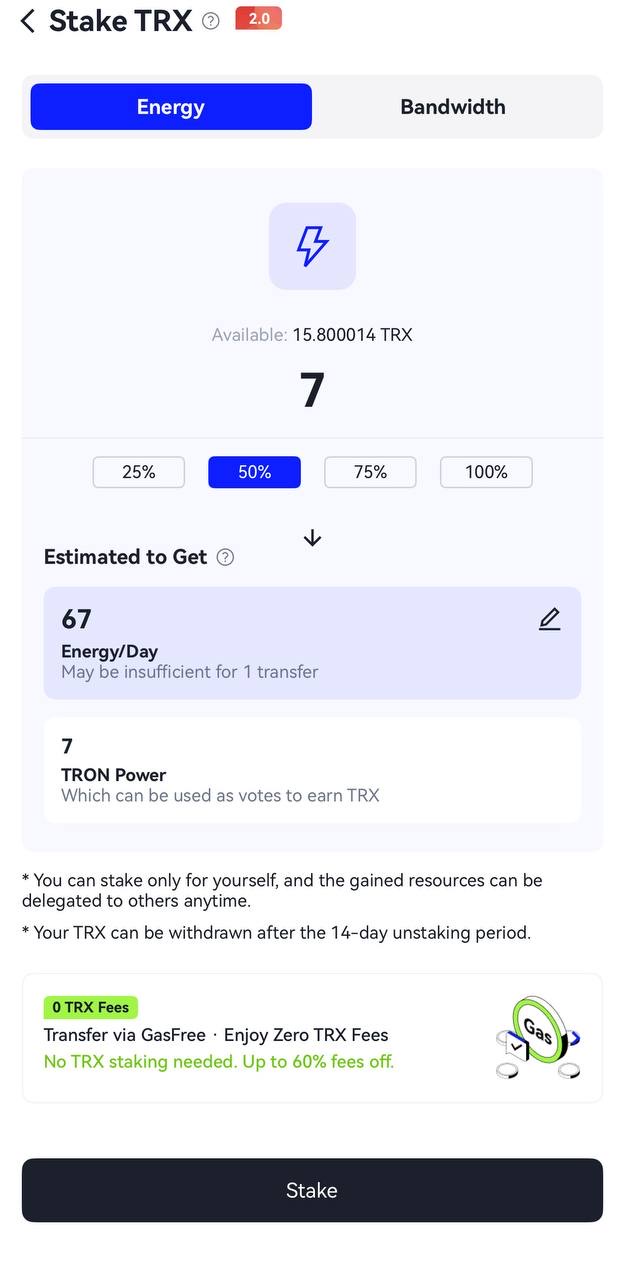
Trust Wallet and MetaMask mobile have similar screens, and the choice is always the same tron freeze bandwidth or energy decision: tron freeze energy for USDT and other token transfers, bandwidth for plain TRX transfers.
How much energy you get per TRX
The answer to “tron staking energy per trx” changes every day, because it depends on how much TRX the whole network has staked:
energy per TRX per day = 180,000,000,000 ÷ total TRX staked for energy
On October 29, 2026 that is about 9.7 energy per staked TRX per day (and about 1.6 bandwidth per TRX for bandwidth stakes). Translated into USDT transfers:
| Daily need | Energy per day | TRX to stake (approx.) | Value (live) |
|---|---|---|---|
| 1 transfer to a USDT holder | 64,285 | ~6,600 TRX | ≈ $2197.80 |
| 1 transfer to a new address | 130,285 | ~13,400 TRX | ≈ $4462.20 |
| 5 transfers to holders | 321,425 | ~33,100 TRX | ≈ $11022.30 |
Use this tron staking calculator energy tool to plug in your own numbers. It reads the live staking ratio from TronGrid:
Stake 2.0 energy calculator
- Energy per day
- —
- USDT transfers per day
- —
- TRX to stake
- —
- Renting the same for 30 days costs
- —
Need more than this? Our TRON staking energy calculator has a separate page with tables for 1, 5 and 20 transfers a day.
Unstaking period and risks
Staking is not free money. Before you lock TRX, know the trade-offs:
- 14-day unstaking period. After you unstake, the TRX is locked for another 14 days before you can withdraw it.
- Price risk. Your TRX stays exposed to the TRX price the whole time. Staking does not protect you from a price drop.
- Shrinking share. If more TRX gets staked network-wide, your energy per TRX goes down — the same stake covers fewer transfers.
- Unused energy is wasted. Energy regenerates whether you use it or not; on days you don’t send USDT, the stake earns you nothing but voting rewards.
- Delegation locks. If you delegate energy with a lock period (up to about 30 days), you cannot reclaim it earlier.
None of this risks your funds directly — staked TRX stays at your address and only you can unstake it.
When staking pays off and when renting is cheaper
Compare the two for one transfer a day to a USDT holder, over 30 days:
| Stake 2.0 | Rent energy | |
|---|---|---|
| Upfront | ~6,600 TRX locked (≈ $2197.80) | nothing |
| Cost over 30 days | 0 TRX burned | 30 × 3 = 90 TRX (≈ $29.97) |
| Flexibility | 14 days to get TRX back | stop any time |
| Extra | voting rewards | — |
Staking pays off when you already hold thousands of TRX long-term and send USDT every day — the energy is a by-product of a position you would hold anyway.
Renting is cheaper when you hold little TRX, send irregularly, or simply don’t want TRX price exposure. 90 TRX a month is far less than the opportunity cost of locking ~6,600 TRX for most people. You can buy tron energy for a single transfer in seconds — 65,000 energy for 3 TRX.
Freeze tron for bandwidth or energy? If you send USDT — energy. Bandwidth matters only for plain TRX transfers beyond your 600 free daily points; the differences are explained in tron bandwidth vs energy. People who search “tron freeze for bandwidth or energy” — or the common typo “freeze tron for bandwidth of energy” — are usually asking exactly this question.
For the full comparison of staking, renting and burning, step by step, see how to get tron energy.
FAQ
How long is the unstaking period?
14 days (the network parameter UnfreezeDelayDays). After you unstake, your TRX stays locked for 14 days and then you withdraw it with a separate transaction. During that time it produces neither energy nor voting power. You can cancel a pending unstake and restake if you change your mind.
Can I stake for bandwidth instead?
Yes — in the same Stake 2.0 screen you choose Bandwidth instead of Energy. Today 1 staked TRX gives about 1.6 bandwidth per day. Bandwidth only helps with plain TRX and TRC10 transfers and with the size part of every transaction; it does not cover the energy that USDT transfers need.